Scars of Gold: The Art of Kintsugi
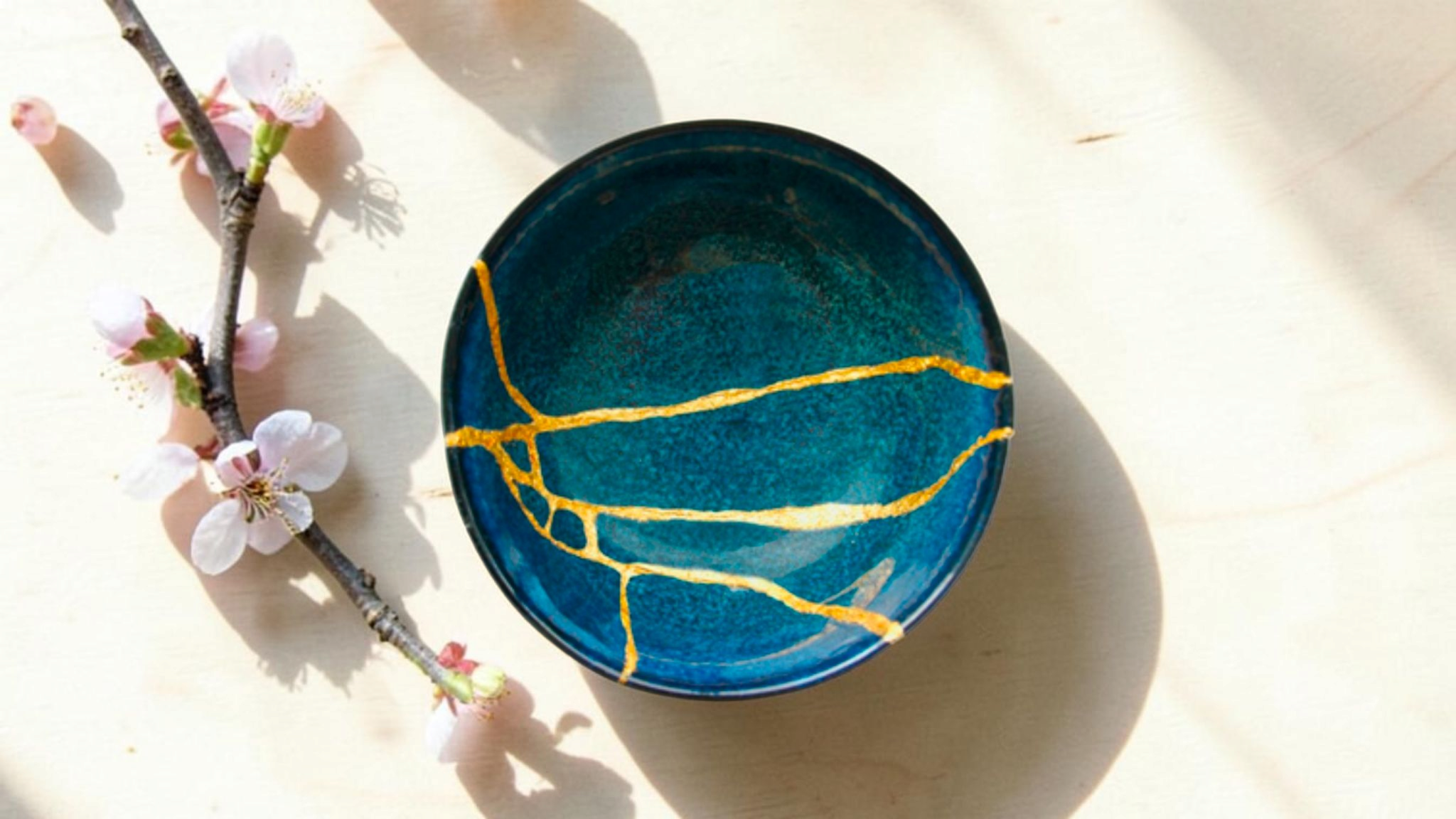
A potter's guide to the history, philosophy, and practice of golden repair, and why it matters more now than ever.
By Lin Kensington | CeramicsIQ
Every potter knows the sound. That quiet crack when you open the kiln and realize a piece didn't survive. A bowl you spent hours shaping, trimming, glazing, split by forces you couldn't control. The instinct is to feel like you failed. The piece is ruined.
Kintsugi offers a different way to hear that sound.
What Is Kintsugi?
Kintsugi, literally "golden joinery," is the practice of repairing broken ceramics with lacquer and powdered gold. Rather than disguising the damage, the technique highlights it. The cracks become luminous gold seams that map the history of the object. The repair doesn't try to erase what happened. It makes what happened part of the beauty.
Also known as kintsukuroi, meaning "golden repair," kintsugi transforms a moment of destruction into a visible act of care. The broken piece doesn't go back to how it was. It becomes something new, something that carries its history on its surface.
For those of us who work with clay, that idea resonates on a level that's hard to explain to someone who hasn't pulled a cracked pot out of a kiln. We already live with unpredictability. We already know the fire gets the final vote. Kintsugi just gives that reality a name, and a gold line.
Where Kintsugi Came From
The most commonly told origin story places kintsugi in late 15th-century Japan. Ashikaga Yoshimasa, the eighth shogun of the Muromachi period, broke a favorite Chinese celadon tea bowl and sent it to China for repair. It came back held together with metal staples. Functional, but ugly.
Yoshimasa wanted something better. Japanese craftsmen responded by developing a repair method using urushi lacquer, a natural resin harvested from the sap of the lacquer tree, bonded with powdered gold. The result was not only functional but striking. The gold didn't hide the break. It celebrated it.
Whether every detail of that story is historically precise is debated, but the timeline holds. Kintsugi emerged alongside the Japanese tea ceremony during the Muromachi period, roughly the 1300s through the 1500s. The two traditions grew together, sharing a reverence for simplicity, humility, and the beauty found in things that aren't perfect.
The roots run even deeper. Japanese craftsmen had been using urushi lacquer to repair pottery for thousands of years. Archaeological evidence of lacquer-bonded ceramics dates back roughly 4,000 years. What kintsugi added wasn't the repair itself. It was the gold. The deliberate choice to make the mend visible and precious.
Collectors during the Muromachi and Edo periods became so enamored with kintsugi that some were reportedly accused of deliberately breaking perfectly good tea bowls just to have them repaired with gold. The repaired version, with its unique golden map of fracture lines, was considered more interesting than the original.
The Philosophy: Why Gold Instead of Glue
Kintsugi sits at the intersection of several ideas in Japanese aesthetics, but it isn't only a Japanese idea anymore. The philosophy has resonated across cultures because it speaks to something universal: the question of what we do with broken things.
Wabi-sabi is the acceptance of imperfection and the beauty of transience. A kintsugi-repaired bowl carries evidence of its life. The gold lines are proof that something happened, and that someone cared enough to respond with intention rather than disposal.
Mushin is the concept of non-attachment, releasing the need for things to remain as they were. A bowl broke. That's not the end. It's a change.
Mottainai is a deep sense of regret over waste. When an object represents hours of human labor and intention, discarding it over a crack feels wrong. Repair it. Let it continue.
These ideas aren't exclusive to Japan. Every culture has some version of the impulse to mend rather than discard, to find value in what's worn and weathered. What kintsugi contributes is a specific, visible practice: instead of making the repair invisible, you make it the most beautiful part of the object.
In most Western restoration traditions, the goal has historically been invisibility. A perfect repair is one you can't see. Kintsugi inverts that entirely. The gold says: something happened here, and that's not a flaw. It's a feature.
That inversion is a big part of why kintsugi has taken off worldwide. It's about a shift in how we think about objects, and about imperfection.
Why Kintsugi Is Resonating Now
Kintsugi's explosion in global popularity isn't accidental. It was referenced in the closing ceremony of the 2021 Paralympic Games as a symbol of resilience and renewal. Workshops have popped up in cities from New York to London to Sydney. DIY kits sell in the hundreds of thousands.
Part of this is the therapeutic appeal. There is something genuinely meditative about taking a broken object and carefully, slowly putting it back together. The focus required, the patience, the act of transforming damage into something intentionally beautiful… it's calming in a way that's hard to replicate with a screen.
But there's something deeper happening too.
We live in a world that's increasingly machine-made and mass-produced. Objects arrive in identical boxes, manufactured by the thousands, designed to be replaced rather than repaired. When something breaks, the default response is to order another one. The object has no history, no hand, no story. It's interchangeable.
Kintsugi pushes back against that. A kintsugi-repaired piece is the opposite of disposable. It's an object that someone made by hand, that broke, and that another set of hands chose to restore with care and precious materials. Every gold line is a small act of defiance against throwaway culture.
For people discovering handmade ceramics for the first time, kintsugi is often the gateway. It's the thing that makes them stop and think about what it means for an object to have a life; to be shaped by human hands, used, broken, and brought back. That's a powerful entry point into the larger world of studio pottery and functional ceramics.
It's also reconnecting people with something fundamental: the humanity in objects. In a moment when AI can generate images and machines can print forms, the mark of a human hand, including breakage and repair, has become more meaningful, not less. Kintsugi is popular now because people are hungry for things that feel real. And nothing feels more real than a bowl with a gold scar.
The Traditional Method: Urushi Lacquer and Real Gold
Traditional kintsugi is not a weekend project. It is slow, physically demanding, and takes weeks to months to complete. That slowness is part of the point.
The process uses urushi, a natural lacquer harvested from the sap of the Toxicodendron vernicifluum tree, a relative of poison ivy. Working with raw urushi requires serious precautions. It can cause skin reactions similar to poison ivy, and traditional artisans build tolerance over years of exposure. Gloves, masks, and careful handling are essential.
The broken pieces are cleaned and fitted back together. A lacquer adhesive, urushi mixed with rice flour or wheat flour, is applied to the broken edges. The pieces are joined and placed in a humidity-controlled environment called a furo, because urushi doesn't air-dry like conventional adhesive. It polymerizes in warm, humid conditions, typically 70 to 80 percent humidity at around 70 degrees Fahrenheit.
If fragments are missing, a putty made from urushi and fine clay powder fills the gaps. Multiple layers are applied with drying time between each. Once the structural repair is complete, the surface is refined and smoothed. Final layers of urushi are applied, and powdered gold, usually 22 or 24 karat, is carefully dusted onto the wet lacquer along the repair lines. The gold isn't melted or poured. It's applied as a fine powder that bonds with the lacquer as it cures, creating those distinctive luminous seams.
A simple repair can take a month. Complex restorations with multiple breaks or missing pieces can take two to three months.
One critical detail: when done traditionally with real urushi lacquer and pure gold powder, the finished repair is food-safe once fully cured. Urushi has been used on Japanese tableware for centuries. A traditionally repaired kintsugi bowl can go right back into daily use, holding tea, serving rice, living on your table. That's the whole philosophy made functional.
Three Styles of Kintsugi
There are three recognized approaches, each with a different visual result.
Crack (hibi) is the most common. Gold lacquer follows the natural crack pattern, creating fine luminous lines across the surface. The repair is minimal and elegant.
Piece method (kake no kintsugi) is used when a fragment is missing entirely. The gap is filled with a gold-lacquer compound, creating a solid gold patch where the missing piece once was.
Joint call (yobitsugi) is the most adventurous. A fragment from a completely different vessel is used to replace the missing piece, creating an intentional patchwork. The mismatch is the point; two histories meeting in one object.
A Potter's Perspective: What Makes a Piece Worth Repairing
Not every broken piece is a candidate for kintsugi. A mug that cracked because the walls were uneven and the clay body was stressed? That's a learning experience, not a restoration project. Reclaim the clay and make a better one.
But a bowl that survived the kiln beautifully and then slipped off the counter three years later… that's a different story. That piece had a life. It was used, held, washed, reached for. The break isn't a flaw in the making. It's an event in the living.
The clay body matters too. Stoneware and porcelain are the best candidates for kintsugi because they're vitrified; dense, strong, and non-porous. Earthenware can be repaired, but its porosity makes the bond less durable over time. Glazed surfaces give the gold a clean contrast. Unglazed surfaces create a more subtle, organic look where the gold meets raw clay.
If you're a potter considering kintsugi for your own work, think about what the gold line will do to the piece visually. A crack across a simple, quiet glaze can become the most compelling feature of the entire form. A crack through a busy, heavily decorated surface might just add visual noise. Kintsugi works best when the repair has room to speak.
Modern Kintsugi Kits: What You Need to Know
The surge of interest in kintsugi has created an enormous market for DIY repair kits, most sold through Amazon and craft retailers. These kits typically replace urushi lacquer with epoxy resin or synthetic adhesive and use metallic powder or gold-colored paint instead of real gold.
Here is what matters before you buy one.
Food safety is the most important consideration. Most epoxy-based kintsugi kits are not food-safe. Epoxy formulations vary widely by brand, and many are not FDA-approved for contact with food or drink. If you repair a mug with an epoxy kit and drink your morning coffee from it, you may be ingesting compounds that were never intended to touch food. Some kits do claim food safety; verify that claim specifically. Do not assume.
The word "urushi" is not regulated. Some kits market themselves using terms like "new urushi" or "modern urushi" when the product contains synthetic resin with no actual lacquer tree sap. Read ingredient lists carefully. If it dries in hours instead of days, it's not traditional urushi.
For decorative pieces, modern kits are a great option. If you're repairing a vase, a decorative plate, or a sentimental piece that won't touch food, an epoxy-based kit can produce beautiful results. The gold lines look striking, the process is accessible, and you don't need a humidity box or months of patience.
The therapeutic value is real and worth experiencing. Taking something broken and carefully, intentionally putting it back together is genuinely meditative. The focus required, the slowness of the process, the satisfaction of seeing gold emerge along a crack, is calming and grounding in a way that surprises most people. For a weekend project, a family craft afternoon, or just a quiet hour to yourself, a modern kintsugi kit is a wonderful experience.
If the piece will hold food or drink, invest in traditional materials. Kits using real urushi lacquer and pure gold powder do exist. They cost more, the process takes significantly longer, and you need to handle raw urushi with care. But the result is a genuinely food-safe, historically authentic repair that honors the tradition and lets the piece return to active daily use, which is the entire point.
What Collectors Should Look For
If you're considering purchasing a kintsugi-repaired piece, here's how to evaluate what you're looking at.
Traditional versus modern repair. Authentic urushi-and-gold kintsugi has a warm, slightly textured gold line with subtle variation. Epoxy-based repairs tend to look smoother and more uniform. Neither is wrong, but they represent very different levels of craft and investment. Traditional repairs by skilled artisans can take months and cost accordingly.
The gold line itself. In quality kintsugi, the gold follows the natural break with minimal excess. It should look intentional and controlled, not sloppy or thick. The best kintsugi artisans use 22-karat powdered gold, which has a softer, warmer tone that sits beautifully against ceramic glazes. 24-karat gold powder is brighter and can sometimes feel visually aggressive against quieter surfaces.
The form underneath. Kintsugi can elevate a good pot, but it can't save a bad one. Look at the piece as a whole: the form, the glaze, the weight in your hand. The gold should enhance what was already there, not distract from weakness in the original work.
Provenance and pricing. A traditionally repaired piece by a recognized kintsugi artisan using real urushi and gold is a serious investment. Prices reflect the months of labor involved. Pieces repaired with modern materials should be priced accordingly; still beautiful, but a different category of work.
The Gold Line
Kintsugi asks a simple question: when something breaks, what do you do?
You can throw it away. You can glue it back together and pretend it never happened. Or you can fill the crack with gold and let the repair become the most beautiful part of the story.
That question extends well beyond pottery. But for those of us who make things with our hands, who pull work from kilns knowing the fire had the last word, kintsugi feels less like philosophy and more like common sense. The break happened. Now what?
Now you pick up the pieces. You take your time. And you make something luminous out of what went wrong.
Coming soon: a hands-on review of a kintsugi repair kit, tested on one of my own broken pieces. I'll walk through the full process, the results, and whether it's worth the investment. Subscribe to CeramicsIQ so you don't miss it.
Enjoying this?
Get articles like this weekly.
Continue Reading
Warren MacKenzie: The Ceramics Legend Who Changed American Pottery
I decided to buy one of Warren MacKenzie's shino tea bowls. Holding it for the first time felt like meeting him in person. The marks he left on the clay are etched into eternity.
Ceramics IQ

Best Clay Types for Beginners (and What Actually Matters First)
My first experience with clay was simple. In high school, I used Sculpey Clay to create tiny volleyball players out of colored clay. I turned them into magnets and gave one to each of my teammates.
Ceramics IQ
What Is a Yunomi? The Japanese Tea Cup Built for Daily Use and Deeper Connection
The yunomi isn't precious. It's designed to be held, used, and part of your day. A ceramicist on why the humblest cup in the collection might be the most important one.
Ceramics IQ